

Best AI Search Monitoring Tools in 2026
Search is changing. People increasingly ask complete questions directly to AI platforms instead of relying only on traditional Google search.
That creates a new question for businesses and website owners:
Does AI mention my brand when people ask questions related to my industry?
AI search monitoring tools help answer that question. They can track whether your brand appears in AI-generated answers, which pages are cited, what competitors are mentioned, and how your visibility changes over time.
Platforms such as ChatGPT, Perplexity, Gemini and Google’s AI search experiences can produce different answers depending on the query, sources and system being used. Therefore, AI visibility monitoring is different from traditional keyword-rank tracking.
In this guide, we’ll look at some of the major AI search monitoring tools available in 2026 and explain what each one is designed to do.
What Is AI Search Monitoring?

AI search monitoring is the process of tracking how a brand, website, product or organization appears in AI-generated search answers.
For example, someone might ask:
“What are the best AI tools for small businesses?”
An AI platform could mention several brands and link to different websites.
An AI visibility tool can help you determine:
- Was your brand mentioned?
- Was your website cited?
- Which competitors appeared?
- Which questions trigger your mentions?
- Which websites are being cited?
- How does your visibility change over time?
Ahrefs, for example, separates mentions from citations. A mention means the brand appears in an AI response, while a citation means the response links to the brand’s website or source.

Why AI Search Monitoring Matters
Traditional SEO focuses heavily on rankings in search engine results.
AI search requires additional measurements.
A website can rank for a traditional keyword but still not appear when someone asks an AI assistant a related question.
AI monitoring can therefore provide another layer of visibility data.
Some important metrics include:
AI Mentions
How frequently a brand appears in AI-generated responses.
AI Citations
How frequently a website or page is referenced as a source.
AI Share of Voice
How much visibility a brand receives compared with other brands in the tracked dataset.
Prompt Visibility
Whether a brand appears for specific questions or prompts.
These metrics are increasingly used as part of AEO (Answer Engine Optimization) and GEO (Generative Engine Optimization) strategies.
Best AI Search Monitoring Tools
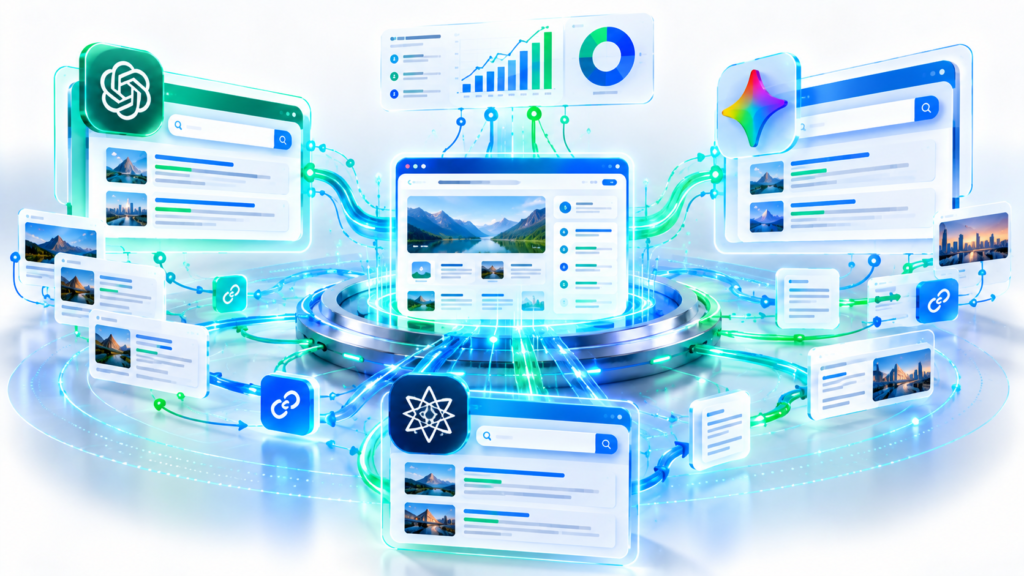
1. Ahrefs Brand Radar
Ahrefs Brand Radar is designed to monitor brand visibility across AI search and other discovery channels.
According to Ahrefs, Brand Radar tracks AI visibility across platforms including Google AI Overviews, Google AI Mode, ChatGPT, Perplexity, Gemini and Microsoft Copilot. Its current product information also describes a large search-backed prompt database and custom prompt tracking.
Useful capabilities include:
- AI brand mentions
- AI citations
- Competitor comparison
- Custom prompts
- Cited pages
- Cited domains
- AI Share of Voice
- Search visibility data
One useful distinction is that Ahrefs uses search-backed prompts rather than treating AI visibility like a conventional fixed keyword ranking system.
Best suited for: SEO professionals, agencies, content teams and businesses already using Ahrefs.
2. OtterlyAI
OtterlyAI is focused specifically on AI search monitoring and optimization.
Its documentation says the platform tracks brand and content visibility across Google AI Overviews, ChatGPT, Perplexity, Google AI Mode, Gemini and Microsoft Copilot, with Claude also supported through its API-based approach.
OtterlyAI also reports daily monitoring across its supported AI search engines.
Typical use cases include:
- Monitoring brand mentions
- Tracking competitors
- Monitoring prompts
- Finding visibility gaps
- Checking how brands are described
- Tracking AI search changes
Best suited for: Businesses and marketers looking for dedicated AI-search monitoring.
3. Profound
Profound is another platform in the AI search monitoring category. It is aimed particularly at organizations that want deeper visibility into how AI search experiences represent their brands and content.
AI-search monitoring platforms such as Profound can be useful for larger SEO and marketing teams that need ongoing prompt tracking, competitive analysis and reporting.
Best suited for: Larger organizations, enterprise SEO and marketing teams.
4. Scrunch
Scrunch focuses on AI visibility and understanding how brands appear in generative search experiences.
Typical monitoring workflows in this category include:
- Brand visibility
- Competitor mentions
- AI responses
- Source citations
- Prompt tracking
- Content opportunities
Best suited for: Brands and marketing teams working on GEO/AEO strategies.
5. Semrush AI Visibility Tools
Semrush combines traditional SEO capabilities with AI visibility features.
This can be useful for teams that don’t want to separate their traditional search analysis from their AI-search analysis.
A combined workflow can include:
Keyword research → Content optimization → Traditional rankings → AI visibility → Competitor analysis
Best suited for: SEO teams already using Semrush.
6. SE Ranking
SE Ranking is another SEO platform expanding into AI visibility and generative search monitoring.
For website owners, having traditional SEO data and AI visibility data together can make it easier to compare conventional search performance with emerging AI-search visibility.
Best suited for: Small businesses, agencies and SEO professionals looking for a broader SEO platform.
AI Search Monitoring vs Traditional SEO Tracking

The two approaches are related but not identical.
| Traditional SEO | AI Search Monitoring |
|---|---|
| Tracks search rankings | Tracks AI mentions and citations |
| Focuses on keywords | Focuses on questions/prompts |
| Google results are central | Multiple AI platforms can be tracked |
| Position is important | Visibility and citation are important |
| SERP features | AI-generated answers |
| Backlinks and rankings | Mentions, citations and sources |
AI assistants can generate different answers for different prompts and sessions, so AI visibility should generally be treated as a measurement based on tracked samples rather than a perfect record of every AI conversation. Ahrefs explicitly notes that it cannot access private conversations or internal OpenAI data.
What Should You Monitor?
If you’re just getting started with AI search optimization, don’t try to track hundreds of random questions.
Start with questions that are closely connected to your business.
For example, if you sell an AI writing product, monitor prompts such as:
- Best AI writing tools
- Best AI tools for bloggers
- AI tools for content marketing
- AI writing tools for small businesses
- Best alternatives to [competitor]
- [your brand] review
- [your product] alternatives
Then monitor:
1. Brand mentions
Does the AI mention your brand?
2. Citations
Does it link to your website?
3. Competitors
Which competing brands appear?
4. Sources
Which websites are being cited?
5. Changes over time
Is your visibility changing?
How to Improve Your AI Search Visibility


Monitoring is only the first step.
Once you know where your brand appears—or doesn’t appear—you can improve your website’s information architecture and content.
Create genuinely useful content
Answer real questions instead of producing pages designed only around keywords.
Build topical authority
Create interconnected content around your core subject.
Make important information easy to understand
Clear headings, definitions, comparisons, tables and concise explanations can make content easier for both users and search systems to interpret.
Strengthen your website’s credibility
Maintain accurate information about your business, products, authors and organization.
Earn relevant mentions
AI systems can use information from multiple sources. Building a strong overall web presence can therefore matter beyond your own website.
Keep important pages updated
Product information, pricing, features and other changing information should be reviewed regularly.
Are AI Search Monitoring Tools 100% Accurate?
No.
This is an important point.
AI-generated answers can vary based on the platform, prompt, model, search context and time.
Therefore, an AI visibility tool should be treated as a monitoring and research system, not as a perfect measurement of every AI answer on the internet.
Ahrefs describes its approach as sampling AI responses using large sets of search-backed prompts, while OtterlyAI describes automated monitoring of tracked prompts across supported AI search engines.
Frequently Asked Questions
AI search monitoring tools track how brands, websites, products or organizations appear in AI-generated answers from platforms such as ChatGPT, Perplexity, Gemini and Google AI search.
AI visibility describes how frequently and prominently a brand appears in AI-generated answers for relevant questions. Metrics can include mentions and citations.
A mention means the AI response names your brand. A citation generally means your website or another source associated with your brand is linked or referenced as a source.
Yes. Several AI visibility platforms offer ChatGPT monitoring. For example, Ahrefs Brand Radar and OtterlyAI both document ChatGPT tracking.
No. Traditional SEO focuses heavily on search-engine visibility and rankings, while AI search monitoring focuses on how AI-generated answers mention, describe and cite brands and sources.
GEO stands for Generative Engine Optimization. It generally refers to optimizing a brand or website’s presence in AI-generated search experiences.
Final Thoughts
AI search is becoming an additional discovery channel alongside traditional search engines.
For website owners, the important question is no longer only:
“Where does my website rank?”
It can also be:
“When people ask AI questions related to my topic, does my brand appear?”
Tools such as Ahrefs Brand Radar, OtterlyAI, Profound, Scrunch, Semrush and SE Ranking provide different approaches to monitoring this emerging form of visibility. The right choice depends on the platforms you need to monitor, the number of prompts, reporting requirements and whether you also need traditional SEO functionality.
For a small website, starting with a limited set of important prompts and tracking them consistently can be more practical than trying to monitor everything.